
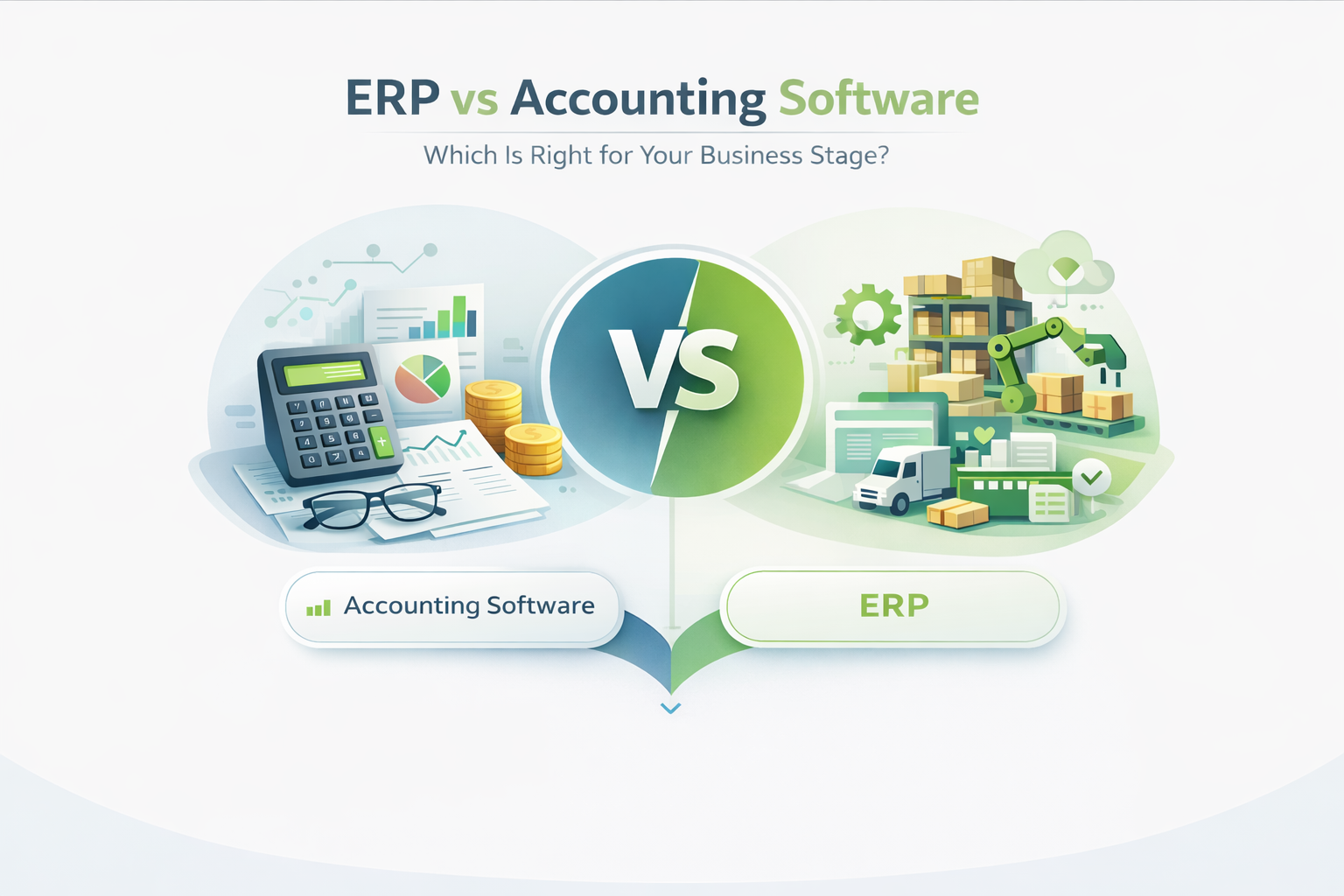
Choosing the right software is one of the most important decisions your business will make, because it directly shapes how you operate, scale, and grow. The right software can accelerate your growth. The wrong one can slow everything down long before you realize why.
Many growing businesses start with accounting software and eventually consider an ERP system. The confusion comes when those two tools start to overlap. They both track money. They both generate reports. They both promise visibility.
But they are built for very different stages of a business.
Understanding when accounting software is enough and when an ERP becomes necessary can save you money, frustration, and painful migrations later.
Let’s break it down.
What Accounting Software Is Designed For
Accounting software is built to answer one core question:
How is my business performing financially?
It focuses on:
- General ledger and journal entries
- Accounts receivable and payable
- Bank and credit card reconciliation
- Financial statements like profit and loss, balance sheets, and cash flow
For early-stage businesses, this is often exactly what’s needed.
Accounting software works best when:
- You have a small team
- Sales volume is manageable
- Inventory is simple or nonexistent
- Most operations happen outside the system
- You mainly need financial visibility, not operational control
At this stage, accounting software is fast to implement, affordable, and easy to use. It does its job well.
Where Accounting Software Starts to Break Down
As a business grows, complexity sneaks in quietly.
You might notice things like:
- Inventory tracked in spreadsheets
- Sales orders managed in one tool, fulfillment in another
- Manual data entry between systems
- Delayed or inaccurate inventory numbers
- Reports that explain what happened, but not what is happening
Accounting software records the financial outcome of operations. It does not manage the operations themselves.
That gap becomes costly as volume increases.
What an ERP System Is Designed For
An ERP system is built to answer a different question:
How does my business actually run, end to end?
ERP systems connect operational workflows across the company, including:
- Sales orders and invoicing
- Inventory and purchasing
- Warehousing and fulfillment
- Manufacturing or assembly
- Financials and reporting
Instead of stitching together tools and spreadsheets, everything lives in one system with a shared source of truth.
ERP systems are designed for businesses that:
- Manage inventory across locations
- Process high order volumes
- Sell through multiple channels
- Need real-time operational visibility
- Want consistency and control as they scale
ERP is not just accounting plus more features. It is a fundamentally different approach.
The Key Difference: Recording vs Running the Business
This is the simplest way to think about it:
- Accounting software records what happened
- ERP systems manage what is happening
Accounting software is reactive. ERP is operational.
That distinction matters more as teams grow and decisions need to be made quickly and confidently.
Which Is Right for Your Business Stage?
Here’s a practical way to think about it.
Early Stage
If your business is small, inventory is simple, and most processes are manual or informal, accounting software is likely the right choice. It keeps costs low and complexity manageable.
Growth Stage
If you are juggling inventory, sales, fulfillment, and reporting across multiple tools, you may feel growing friction. This is often when businesses start considering ERP, even if they are not ready to switch immediately.
Scaling Stage
When accuracy, consistency, and efficiency become critical, ERP becomes less of a nice-to-have and more of a foundation. At this stage, continuing to rely on accounting software alone often creates bottlenecks.
A Common Mistake to Avoid
Many businesses wait too long to evaluate ERP because they assume it will be overwhelming or disruptive.
In reality, the most painful implementations happen when teams are already stretched thin and systems are breaking under pressure.
Evaluating ERP earlier does not mean committing earlier. It simply means planning with clarity instead of urgency.
Final Thoughts
There is no universally right answer. The right system depends on where your business is today and where it is heading next. Accounting software is excellent for financial clarity in the early stages. ERP systems are built to support operational complexity as businesses grow.
The key is choosing the right tool for your current stage while keeping the next stage in mind.
Ready to see Aquilon in action?
Find out if Aquilon is the right fit for your business.