
Have you ever looked at your margins and thought, “These seem better than they actually are” or “Something doesn’t quite add up”?
On paper, everything looks fine. Your purchase prices are reasonable. Sales are steady. But once all the costs shake out, the profits don’t feel as strong as expected.
One common reason this happens is that not all costs are being accounted for when inventory is valued. That gap between what you think your products cost and what they actually cost is where landed cost tracking comes into play.
What is Landed Cost Tracking?
At its core, landed cost tracking is about figuring out what a product actually costs you once it’s sitting in your warehouse and ready to sell.
Not the sticker price from the supplier.
The real cost.
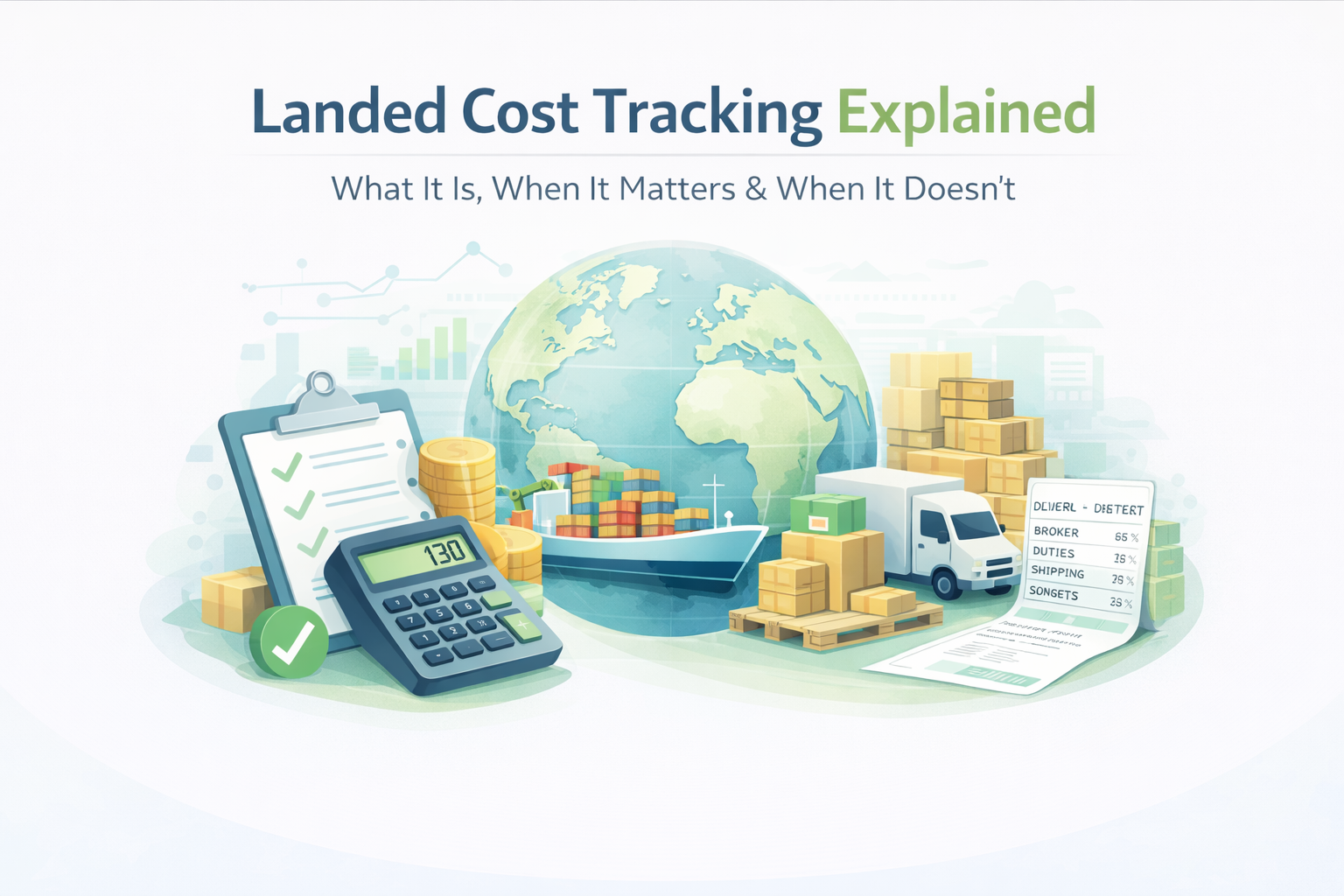
If you buy something for $100 but spend another $30 getting it to your warehouse, the product does not cost $100. It costs $130. The landed cost is how you capture that full picture.
Most businesses don’t feel this pain right away. It usually shows up later, when margins start looking “off” and no one can quite explain why.
What Costs Are Included in Landed Cost Tracking?
Landed cost typically includes one-time costs tied to acquiring and receiving inventory.
Common examples include:
- Supplier purchase price
- Freight and shipping
- Customs duties and tariffs
- Brokerage fees
- Import taxes
- Sometimes insurance during transit
The key idea is this:
If the cost exists because you bought and imported the item, it usually belongs in landed cost.
If the cost exists because you’re running a warehouse, it usually does not.
Handling Landed Cost Without Software
Most businesses start without landed cost tracking. And honestly, that’s fine at the beginning.
Here’s what that usually looks like:
- Inventory is received at supplier cost only
- Freight and duties are expensed separately
- At month end, finance might do a rough adjustment
- Or they don’t adjust at all
Sometimes there’s a spreadsheet. Sometimes there’s just tribal knowledge and gut feel.
This works when:
- Volumes are low
- Shipping costs are predictable
- Margins are healthy enough to absorb inaccuracies
The problem is not that this approach is “wrong”.
The problem is that it quietly stops working as complexity increases.
When Landed Cost Becomes Harder to Manage
As the business grows, landed costs naturally become more complex and harder to manage manually.
As soon as any of these show up, cracks start forming:
- Multiple shipments per purchase order
- Freight invoices arriving weeks later
- Partial receipts
- Currency differences
- Volatile shipping costs
- Tighter margins
Now inventory values are off, COGS doesn’t reflect reality, and reported margins don’t match what the business is actually experiencing.
At this point, teams start arguing about numbers instead of making decisions. Finance doesn’t trust inventory. Operations doesn’t trust reports. Leadership loses confidence in pricing.
That’s usually the moment landed cost tracking stops being “nice to have” and starts becoming necessary.
Common Landed Cost Approaches in ERP Systems
Not all ERP systems handle landed cost the same way. Most fall into one of two approaches.
Manual landed cost
- Inventory is received at supplier cost
- Freight, duties, and other charges are handled later
- Costs are allocated using spreadsheets or journal entries
- Works early on, but breaks down as volume and complexity increase
Integrated landed cost
- Landed costs are tied directly to purchase orders and receipts
- Additional costs are allocated across items automatically
- Inventory value and COGS reflect the full cost of the item
Neither of these approaches is better than the other. The right one depends on how complex your inbound costs are and how much you rely on accurate margins.
Aquilon uses an integrated approach but doesn’t lock you into a single method. It supports multiple ways of handling landed cost, depending on how your business accounts for costs.
Do you need landed cost tracking?
Here’s the honest answer.
You probably do not need landed cost tracking if:
- You buy domestically
- Shipping costs are small and stable
- You sell high-margin products
- You rarely analyze margin by SKU
You probably do need it if:
- You import goods
- Freight and duties are meaningful
- Margins are tight
- You rely on SKU-level profitability to make decisions
- Inventory values matter to reporting and forecasting
Landed cost tracking is not about perfection.
It’s about confidence.
When numbers matter more, accuracy matters more.
Putting Landed Cost in Context
Landed cost tracking isn’t about chasing perfect numbers or adding complexity for its own sake. It’s about understanding what your products truly cost so you can trust the decisions you’re making.
For some businesses, simple methods are enough for a long time. For others, growing volume, tighter margins, or more complex supply chains make landed cost accuracy harder to ignore.
The important thing is knowing when that shift happens.
Once you understand how landed cost fits into your business, it becomes much easier to decide whether your current approach is still working, or if it’s time to handle it differently.
That clarity is what landed cost tracking is really for.

Ready to see Aquilon in action?
Find out if Aquilon is the right fit for your business.