
Switching to a new ERP system can be exciting. Your business is preparing for better processes, improved data, and greater efficiency. However, once the ERP implementation begins, that excitement can quickly turn into stress.
Suddenly, employees may question the decision. The old ERP system can start to look easier and more efficient.
This reaction is common. In fact, it is one of the most predictable ERP implementation challenges businesses face.
The problem is not necessarily the new ERP software. Instead, your team is comparing a system they have used for years with one they have only started learning.
That is not a fair comparison.
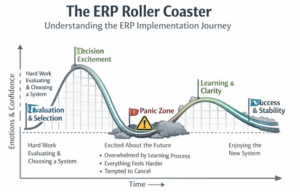
Why Does ERP Implementation Feel Overwhelming?
An ERP implementation affects many areas of a business at the same time. Employees need to learn new processes while continuing to handle their regular responsibilities.
During an ERP transition, your team may be:
- Learning new workflows and processes
- Cleaning and converting business data
- Testing the new ERP system
- Running old and new systems in parallel
- Training employees
- Identifying data or workflow issues
- Preparing for ERP go-live
- Adjusting to temporary productivity changes
As a result, the early stages can feel overwhelming.
However, temporary frustration does not mean the ERP implementation is failing. Often, it simply means your team is still moving through the learning and adjustment stage.
Why the Old ERP System Suddenly Feels Better
Familiarity is powerful.
Employees may have spent years learning shortcuts and workarounds in the old system. They know where information is located and how to complete everyday tasks.
Even an inefficient process can feel comfortable when you have performed it hundreds of times.
A new ERP system removes that familiarity.
Tasks that once seemed automatic now require thought. Employees need to learn where information is stored, how workflows operate, and how different departments connect.
Therefore, productivity may temporarily decline while people learn the new system.
Over time, those new processes become familiar too.
Break ERP Implementation Into Manageable Steps
Trying to solve every ERP implementation issue at once can quickly become frustrating.
A better approach is to break the project into smaller, manageable steps.
As the saying goes, how do you eat an elephant? One bite at a time.
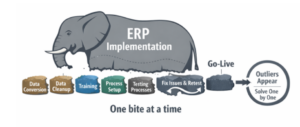
Focus on the most important issue first. Solve it, test the solution, and then move to the next challenge.
This approach helps teams see measurable progress. More importantly, each successful step builds confidence in the new ERP system.
Expect New Issues After ERP Go-Live
ERP go-live is an important milestone, but it is not the end of implementation.
Once employees begin using the system in real-world situations, unusual scenarios will appear.
These may involve processes that happen only once a month, once a quarter, or even once a year. Other issues may involve unusual customer orders, special purchasing situations, or unique accounting requirements.
It is often impossible to identify every one of these situations before go-live.
Therefore, finding an edge case after implementation does not necessarily mean something went wrong.
It may simply be a process that could only be discovered through everyday use.
Solve ERP Issues One at a Time
When an unusual situation appears, document it and determine the best way to handle it.
Then move forward.
Over time, the list of unknowns becomes smaller. Employees become more comfortable, processes improve, and the ERP system becomes part of everyday operations.
The goal should not be a completely problem-free transition. Instead, the goal is to create a structured process for identifying and resolving issues as they appear.
Employee Training Is Part of ERP Success
Technology is only one part of a successful ERP implementation.
Employees also need time to understand how the new system fits into their daily work.
Training, documentation, and ongoing support can help reduce frustration. In addition, employees should understand why processes are changing and how those changes can benefit the business.
As confidence grows, resistance often decreases.
What Is Normal During an ERP Implementation?
Businesses often ask whether stress, confusion, or temporary productivity changes are normal during an ERP transition.
The short answer is yes.
Learning new workflows takes time. Data conversion can uncover old problems. Employees may initially prefer familiar processes. In addition, unusual situations can continue to appear after go-live.
These challenges are a normal part of moving from an established system to a new ERP platform.
What matters is how the business responds.
Moving Beyond the ERP Implementation Roller Coaster
ERP implementation is a process, not a single event.
There may be periods of excitement, frustration, uncertainty, and progress. However, each resolved issue brings your team closer to a stable and more efficient system.
Stay focused on the reasons your business decided to change ERP systems in the first place.
Solve problems one at a time. Give employees time to learn. Continue improving workflows after go-live.
Most importantly, do not mistake the discomfort of change for failure.
With the right approach, an ERP implementation can help create better processes, stronger information flow, and a more efficient foundation for future growth.
Preparing for a New ERP System?
Aquilon ERP is designed for small and mid-sized businesses that need practical tools to manage their operations.
From financial management and inventory to manufacturing, distribution, sales, and purchasing, Aquilon ERP helps connect important business processes within one integrated system.
If your business is considering a new ERP system or preparing for implementation, contact Aquilon Software to learn more about Aquilon ERP and how it can support your business.
