
Helping Small Business Grow Through Practical ERP
ERP Implementation: Why ERP Projects Fail and How to Make Them Successful
By Phil Patton
President, Aquilon Software
Estimated Reading Time: 8–10 Minutes
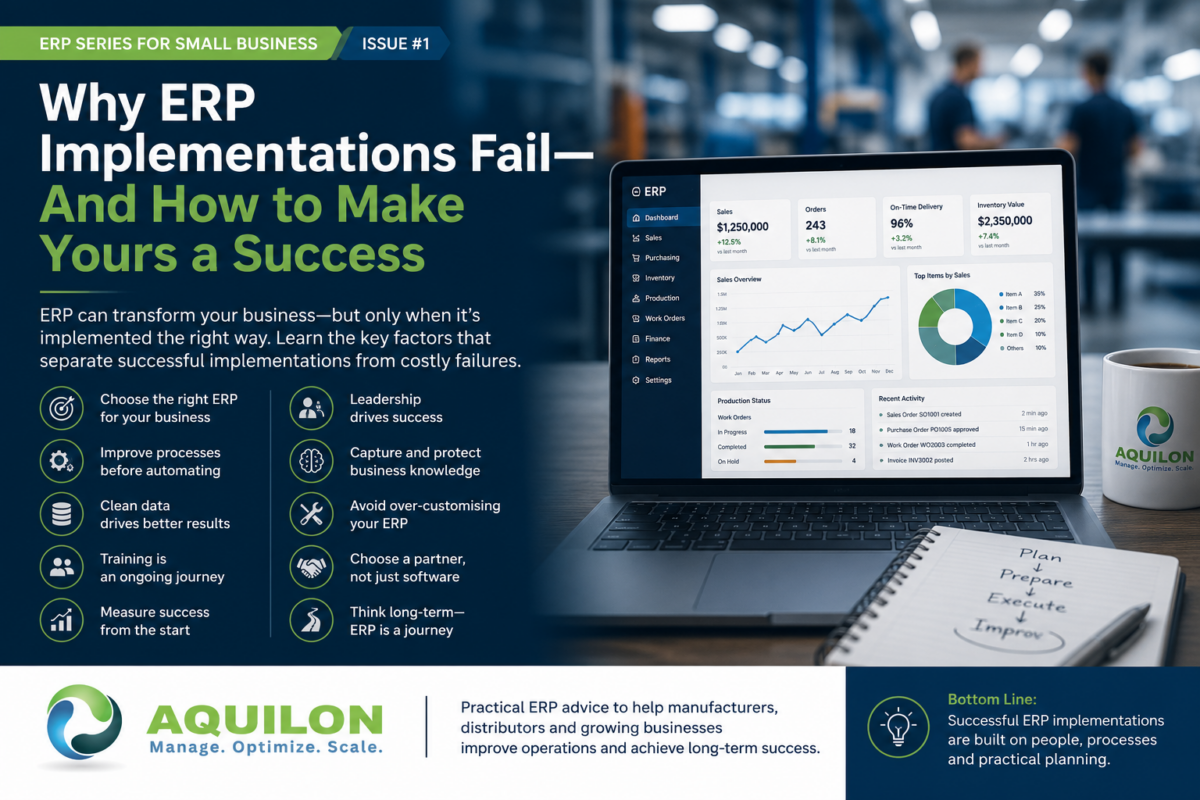
Implementing an ERP system is one of the most important investments a growing business can make. When planned properly, a successful ERP implementation streamlines operations, improves communication, reduces costly mistakes, and provides real-time information that supports better decision-making. As a result, businesses become more efficient, more profitable, and better prepared for future growth.
Unfortunately, not every ERP project delivers these results. Instead, many implementations take longer than expected, exceed their budgets, or fail to achieve the anticipated improvements. However, the software itself is rarely the reason.
After spending decades helping manufacturers, distributors, and growing businesses implement ERP systems, I’ve discovered that successful projects have something in common. Likewise, unsuccessful projects usually share many of the same warning signs.
In most cases, an ERP implementation succeeds—or fails—because of planning, leadership, business processes, and employee engagement rather than technology alone.
Fortunately, nearly all of the most common mistakes can be avoided.
In this first article of The Practical ERP Series for Small Business, I’ll explain why ERP implementations fail and, more importantly, share practical strategies that can help your business achieve a successful implementation from the very beginning.
What Is an ERP Implementation?
An Enterprise Resource Planning (ERP) system connects the most important areas of your business into one integrated solution. Instead of relying on multiple software applications and countless spreadsheets, your accounting, inventory, purchasing, manufacturing, sales, warehousing, customer service, and reporting all work together using the same accurate information.
Consequently, employees spend less time searching for information and more time making informed decisions.
Furthermore, managers gain greater visibility into every aspect of the business. Rather than waiting for reports from multiple departments, they can access real-time information whenever they need it.
Ultimately, a properly implemented ERP system becomes the operational backbone of the organization.
However, even the best software cannot overcome poor planning.
ERP Is a Business Project—Not an IT Project
One of the biggest misconceptions about ERP implementation is that it is simply an IT project.
In reality, it isn’t.
Instead, ERP implementation is a business improvement project that happens to involve technology.
This distinction is extremely important because it changes the focus of the entire project.
Rather than asking,
“How do we install new software?”
successful organizations ask,
“How can we improve the way we operate?”
That shift in thinking influences every decision made throughout the implementation.
For example, departments begin looking for opportunities to eliminate unnecessary work, simplify workflows, and improve communication instead of merely replacing one software package with another.
As a result, the ERP system supports better business practices instead of simply digitizing old ones.
Choose the Right ERP System for Your Business
Many organizations begin evaluating ERP software before they fully understand their own business requirements.
Unfortunately, this often leads to disappointment.
Before looking at software demonstrations, take time to evaluate where your business can improve.
For example, ask questions such as:
- Where do we lose the most time?
- Which manual processes create the most errors?
- Where are spreadsheets still controlling daily operations?
- Which departments struggle to communicate?
- What information do managers wish they had today?
- Where do customers experience unnecessary delays?
- Are there unique business processes that our ERP system must support?
Once these questions have been answered, selecting the right ERP solution becomes much easier.
More importantly, you’ll be choosing software based on business needs rather than attractive features alone.
Remember, your ERP system should support your business—not force your business to adapt to the software.
Executive Leadership Makes the Difference
One of the strongest indicators of ERP implementation success is active leadership from senior management.
When business owners and executives visibly support the project, employees immediately recognize its importance.
Consequently, staff members become more engaged and are generally more willing to embrace change.
Management should provide:
- Clear business objectives
- Timely decisions
- Appropriate resources
- Ongoing communication
- Visible leadership throughout the project
On the other hand, delegating the entire implementation to the IT department—or to one employee—often creates inconsistent decisions, communication problems, and project delays.
Because ERP affects nearly every department, leadership must come from the top.
When management remains actively involved, the entire organization moves in the same direction.
Improve Processes Before You Automate Them
One of the most common mistakes businesses make is using new software to automate inefficient processes.
Unfortunately, technology cannot fix a poor process.
Instead, it simply allows that process to happen faster.
Therefore, every ERP implementation should begin with a careful review of existing business procedures.
Ask yourself one important question:
“If we were starting this company today, would we still do it this way?”
Quite often, the answer is no.
Consequently, an ERP implementation becomes an excellent opportunity to simplify operations before introducing new technology.
Review areas such as:
- Sales procedures
- Purchasing workflows
- Inventory management
- Manufacturing operations
- Warehouse processes
- Financial reporting
In many cases, improving the process delivers even greater benefits than the software itself.
Moreover, cleaner processes make employee training easier and significantly reduce implementation complexity.
Clean Data Leads to Better Decisions
No ERP system can produce accurate information if the data entering it is incomplete or incorrect.
Therefore, one of the most valuable investments you can make before implementation is cleaning your business data.
Take time to review:
- Customer records
- Supplier information
- Inventory items
- Bills of Material
- Product specifications
- Pricing
- Units of measure
Although data cleanup requires time, it almost always saves considerably more time after the system goes live.
Furthermore, clean data improves reporting, reduces frustration, and increases confidence in the new ERP system.
Simply put, better data leads to better decisions.
Employee Training Is an Ongoing Investment
One of the biggest mistakes businesses make is treating employee training as a one-time event. While initial training before the system goes live is essential, it should never be considered the end of the learning process.
Instead, successful organizations view training as an ongoing investment.
As employees become more familiar with the ERP system, they naturally discover new features and more efficient ways to complete their daily work. Consequently, additional training often unlocks capabilities that employees didn’t even know existed during the initial implementation.
Furthermore, every department has different training requirements.
For example:
- Sales teams need confidence creating quotations and processing customer orders.
- Purchasing staff must understand procurement workflows and supplier management.
- Warehouse employees require practical experience with inventory transactions and shipping procedures.
- Accounting personnel need comprehensive training on financial reporting, month-end processes, and reconciliation.
By continuing to invest in employee education, businesses improve productivity, increase user confidence, and maximize the return on their ERP investment.
Capture Your Company’s Knowledge
Every business relies on knowledge that has been developed over many years. Unfortunately, much of that knowledge often exists only in the minds of experienced employees.
For example, this knowledge may include:
- Product configuration rules
- Pricing strategies
- Manufacturing procedures
- Customer-specific requirements
- Inventory practices
- Purchasing policies
- Approval processes
Although experienced employees are invaluable, depending solely on their memory creates significant business risk.
Eventually, employees retire, accept new positions, or move on to other opportunities. When that happens, years of valuable experience can disappear almost overnight.
Fortunately, a well-implemented ERP system helps capture this knowledge and make it part of your organization’s daily operations. As a result, new employees learn more quickly, processes become more consistent, and the business becomes less dependent on any one individual.
For many organizations, preserving business knowledge is one of the most valuable long-term benefits of ERP implementation.
Avoid Unnecessary ERP Customization
Almost every company believes its business is unique.
While every organization certainly has its own culture and processes, most successful manufacturers and distributors actually follow remarkably similar operational principles.
Therefore, modern ERP systems already include many proven industry best practices.
Instead of customizing the software to match every existing process, first consider whether those processes should be improved.
Customizations should be reserved for situations where they provide a genuine competitive advantage.
Otherwise, excessive customization can:
- Increase implementation costs
- Extend project timelines
- Delay future software upgrades
- Increase long-term maintenance costs
- Make technical support more complicated
Whenever possible, allow your ERP system to guide better business practices instead of modifying the software to support outdated procedures.
Consequently, your business will benefit from future software enhancements while keeping long-term ownership costs under control.
Define Success Before the Project Begins
One simple question is often overlooked during ERP implementation:
How will we know if this project has been successful?
Before implementation begins, establish measurable business objectives that everyone understands.
For example, your goals might include:
- Reduce inventory by 15%
- Improve inventory accuracy to 98%
- Reduce quotation preparation time by 50%
- Shorten month-end closing by three days
- Reduce manufacturing errors
- Improve on-time delivery performance
Clearly defined objectives keep the entire project focused.
More importantly, they provide measurable benchmarks that allow you to evaluate the success of your implementation after the system goes live.
Without measurable goals, it becomes difficult to determine whether the project delivered the expected business value.
Choose an ERP Partner—Not Just Software
Selecting the right ERP software is only part of the decision.
Equally important is choosing the right implementation partner.
An experienced ERP consultant brings much more than technical expertise. In addition, they understand business processes, recognize potential risks, and identify opportunities that software demonstrations often overlook.
The best ERP implementations become true partnerships.
Your team contributes valuable knowledge about your business, while your implementation partner provides years of experience, industry best practices, and proven implementation methods.
Together, these strengths dramatically improve the likelihood of a successful project.
ERP Is a Journey, Not a Destination
Many businesses view “go-live” as the finish line.
In reality, it is only the beginning.
The organizations that achieve the greatest return on investment continue improving their ERP systems long after implementation is complete.
For example, they introduce additional functionality, automate more processes, improve reports, refine workflows, and continue training employees.
As their businesses grow, their ERP systems grow alongside them.
Consequently, the ERP system becomes an increasingly valuable business asset year after year.
Rather than viewing ERP as a one-time software purchase, think of it as a continuous improvement strategy that supports long-term growth.
ERP Implementation Checklist
Before beginning your ERP implementation, take a moment to review the following questions:
✔ Do we clearly understand our business processes?
✔ Have we documented our business objectives?
✔ Does senior management fully support and actively lead the project?
✔ Is our business data accurate, complete, and ready for migration?
✔ Has enough time and budget been allocated for employee training?
✔ Are we improving our processes instead of simply automating outdated ones?
✔ Have we selected an experienced ERP implementation partner?
If you answered “No” to several of these questions, addressing them before implementation begins can significantly improve your chances of success.
By investing more time during the planning stage, you’ll reduce risk, minimize disruptions, and increase the likelihood of achieving your business objectives.
Key Takeaways
Although every ERP implementation is different, the most successful projects share several important characteristics.
Successful businesses don’t simply purchase new software. Instead, they focus on improving the way they operate. As a result, their ERP system becomes a valuable business tool rather than just another technology investment.
Before beginning your ERP implementation, remember these key principles:
- Choose an ERP system that supports your business processes.
- Improve existing workflows before automating them.
- Ensure your business data is accurate and complete.
- Invest in ongoing employee training.
- Capture valuable business knowledge so it isn’t lost.
- Keep senior management actively involved throughout the project.
- Establish measurable goals before implementation begins.
- Work with an experienced ERP implementation partner.
- Continue improving your ERP system long after it goes live.
Ultimately, ERP implementation is not about installing software—it’s about building a stronger, more efficient, and more scalable business.
Frequently Asked Questions
Why do ERP implementations fail?
Most ERP implementations fail because of poor planning, unclear objectives, inadequate training, poor-quality data, or a lack of leadership. While many people blame the software, the real challenges usually involve business processes and project management. Therefore, careful planning and strong executive support are essential for success.
How long does an ERP implementation take?
The timeline depends on the size and complexity of your business. For example, a small business may complete an implementation in just a few months, whereas a larger manufacturing or distribution company may require six months or longer. In addition, the amount of data preparation and process improvement will affect the overall schedule.
Is ERP only for large companies?
Not at all. Modern ERP solutions are designed for businesses of every size. In fact, many small and mid-sized businesses experience significant improvements in productivity, inventory control, customer service, and reporting after implementing an ERP system.
Why is employee training so important?
Employee training helps users understand both the software and the business processes behind it. Furthermore, ongoing training allows employees to take advantage of new features and work more efficiently over time. Consequently, businesses achieve a much greater return on their ERP investment.
Should we customize our ERP software?
In most cases, customization should be limited to processes that provide a genuine competitive advantage. Otherwise, unnecessary modifications can increase costs, delay upgrades, and make future support more difficult. Therefore, it’s usually better to adopt proven ERP best practices whenever possible.
Final Thoughts
An ERP implementation is one of the most important investments a growing business can make. However, technology alone does not guarantee success.
Instead, successful implementations are built on careful planning, strong leadership, well-defined business processes, clean data, and ongoing employee engagement.
Although every project presents unique challenges, the businesses that prepare thoroughly and remain committed to continuous improvement consistently achieve the best results.
Most importantly, remember that an ERP implementation is not the end of the journey—it is the beginning of a better way of running your business.
When approached with the right strategy, an ERP system becomes far more than software. It becomes a foundation for improved productivity, better decision-making, stronger customer service, and sustainable long-term growth.
What’s Next in This Series?
In Issue #2 of The Practical ERP Series for Small Business, we’ll explore:
Why Configure-to-Order ERP Is Transforming the Door Manufacturing Industry
You’ll learn:
- How Configure-to-Order (CTO) manufacturing differs from traditional manufacturing.
- Why spreadsheets struggle to manage complex product configurations.
- How ERP reduces costly quoting and production errors.
- Ways manufacturers can improve efficiency while delivering customized products.
- How practical ERP helps manufacturers increase profitability and customer satisfaction.
If your business manufactures custom products, you won’t want to miss the next article in this series.
About the Author
Phil Patton is President of Aquilon Software and has spent decades helping manufacturers, distributors, and growing businesses improve operational efficiency through practical Enterprise Resource Planning (ERP) solutions.
Throughout his career, Phil has worked with organizations across a wide range of industries, helping them streamline operations, improve inventory management, optimize manufacturing processes, and implement practical ERP solutions that support long-term growth.
Rather than focusing solely on software, Phil believes successful ERP projects begin with understanding business processes, empowering employees, and continuously improving the way organizations operate.
Through The Practical ERP Series for Small Business, he shares practical, real-world advice that business owners, managers, and decision-makers can apply immediately—regardless of which ERP system they use.
Ready to Learn More?
Whether you’re planning your first ERP implementation or looking to get more value from your existing system, careful planning is the key to long-term success.
To learn more about practical ERP solutions for manufacturers, distributors, and growing businesses, visit Aquilon Software. Our experienced team can help you evaluate your business processes, select the right ERP solution, and implement a system that supports your company’s growth for years to come.
